Abstract art (also called modern or contemporary art) is art that doesn’t resemble anything from “real life”. It’s an art style that is intentionally non-representational and seeks to achieve its point or subject using shapes, forms, colors, and textures. Every object on the canvas is represented by either colors and or shapes. For example colors can represent emotions and shapes can symbolize objects.
The purpose of abstract is to let the viewer interpret its meaning for him/herself.
More Details
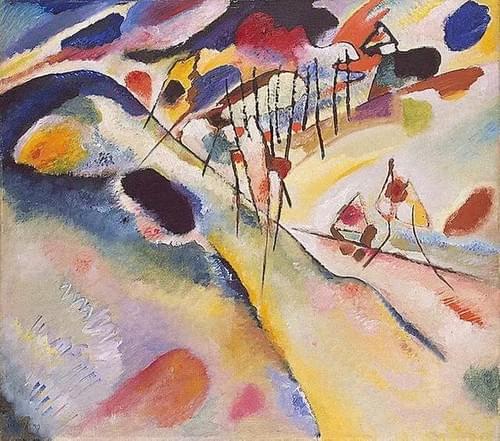
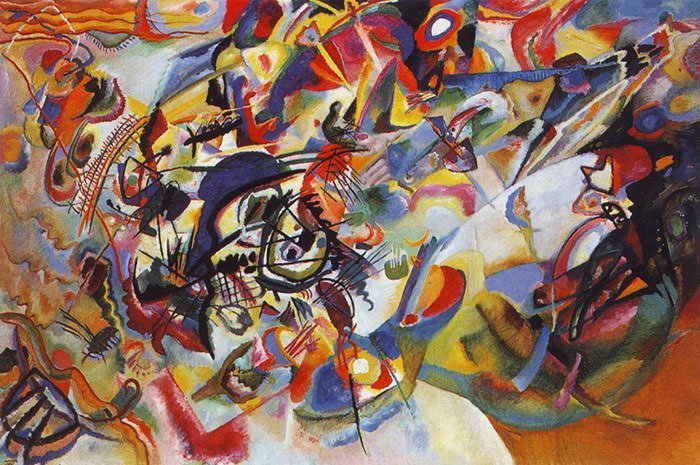
COMPOSITION VII
Year: 1913
Artist: Wassily Kandinsky
Composition VII (1913) – Wassily KandinskyWassily Kandinsky is considered by many as the “Father of Abstract Art” and he painted some of the earliest works in the genre including what is known as the First Abstract Watercolor. The years 1910 to 1914 are considered the peak of Kandinsky’s career and this painting is cited as the pinnacle of his artistic achievement during the period. He made more studies for this composition than for any other, though he painted the final version in just three days. Composition VII is believed to allude to the apocalyptic themes of Deluge, Last Judgement, Resurrection and Paradise. A swirling hurricane of colors and shapes, it was considered by Kandinsky to be the most complex piece he ever painted and it is one of the most renowned pieces of abstract art ever created.
ABSTRAKTE BILDER SERIES
Artist:Gerhard Richter
Abstraktes Bild [599] (1986) – Gerhard RichterGerhard Richter is a German artist considered by some as the greatest living painter. He has created a wide variety of work and his art cannot be put under one particular genre. Among Richter’s most famous works is his Abstrakte Bilder series. He painted the first work titled Abstrakte Bild in 1976 and continued making many such works in the following two decades. In his abstract pictures, Richter builds up cumulative layers of non-representational painting. He begins with brushing big swaths of primary color onto canvas. The paintings evolve in stages, based on his responses to the picture’s progress: the incidental details and the patterns that emerge. In February, 2015, one of the paintings of the series, Abstraktes Bild [599] was sold for $44.52 million (£30.4 million), the highest price paid for a painting by any living European artist.
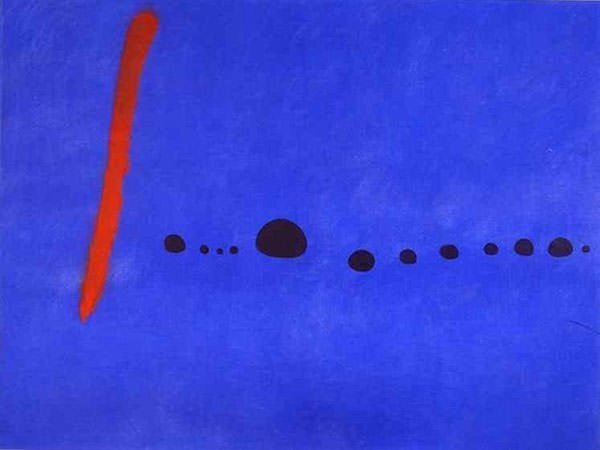
BLEU II
English Title:Blue II
Year:1961
Artist:Joan Miro
Blue II (1961) – Joan Miro
Joan Miro was an influential Spanish artist who was more closely linked to Surrealism but who also painted several abstract masterpieces which are considered a precursor to Abstract Expressionism. His most famous abstract artwork is the Triptych Blue I, II, III consisting of three enormous 355 cm x 270 cm paintings. All three paintings consist of simple lines and shapes on a dreamy blue background. In Blue II, Miro includes a dynamic red line on the left side of the painting in contrast to the serene blue background. The Bleu Triptych is considered a masterly achievement in abstract art and Bleu II is the most renowned of the three paintings.
 Composition VII (1913) – Wassily Kandinsky
![Abstraktes Bild [599] (1986)](https://learnodo-newtonic.com/wp-content/uploads/2017/12/Abstraktes-Bild-599-1986-Gerhard-Richter.jpg)